How have you found the balance of passive and active learning in this course for your learning? How does it compare to your experience in other courses?
I think there is an appropriate balance between passive and active learning in this course. We first explore course material by reading the module and sometimes watching videos, which involves passive learning. Compared to my experience in other courses, I personally found the process of passive learning quite flexible and convenient in this course because I can arrange what time to learn and I do not need to learn it in a short period of time such as having a 50 or 80-minute class. Sometimes it is hard for me to focus on material for an entire class, and if I miss some information, I miss it. However, I do not need to worry about missing some information in this class, because I always can go back to check it, which reduces my stress.
In terms of active learning, we usually have to write a blog to reflect what we learned in this module, and this is a way of active learning. Writing a reflection based on the reflection questions provided helped me to actively interpret and engage with the material. It encourages me to critically think about the material and relate it to my personal experience. Also, we have a chance to read and comment on other peers’ blogs in this course, which is another way of active learning. By reading their blog, I know what others’ thoughts are based on the same content and usually, I am inspired by their ideas. In my other courses, we access active learning through group discussions or group projects. Not every class I have the opportunity to participate in active learning because lectures involve passive learning more. However, one advantage of my offline class is that when we have the chance to discuss, it can foster a connection and be more engaging. All in all, as a student, I believe that it is important to reach a balance between active learning and passive learning. The content might lose a foundation for active learning if passive learning is not present, and in the same way, the content cannot be strengthened if active learning is not present.
Lesson Plan
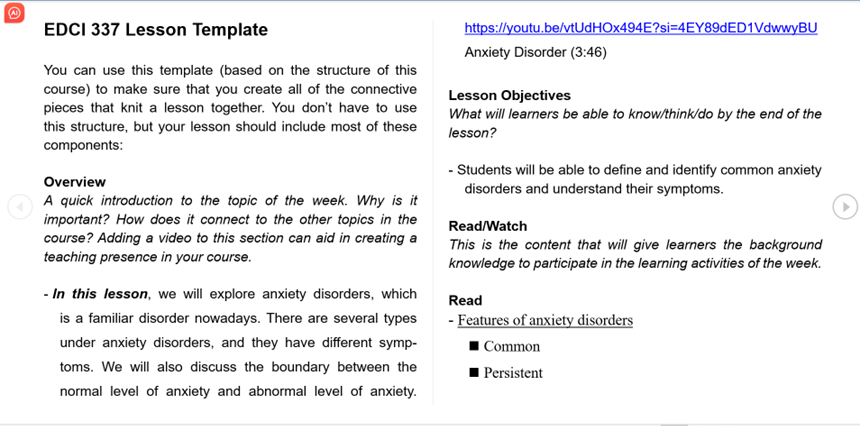
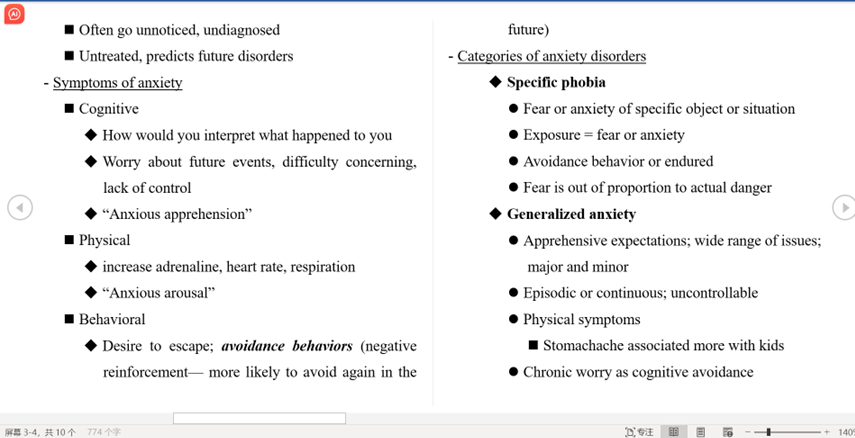
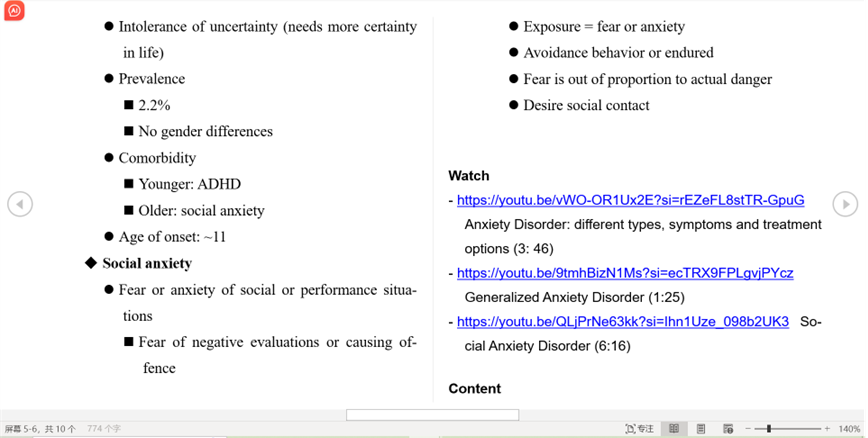
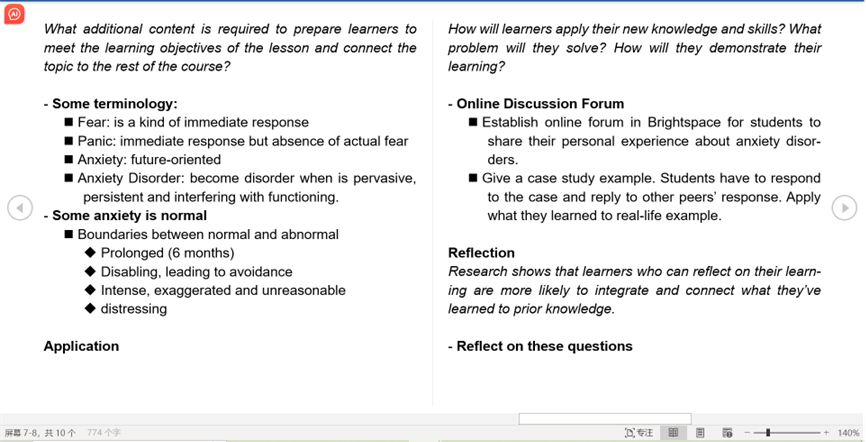
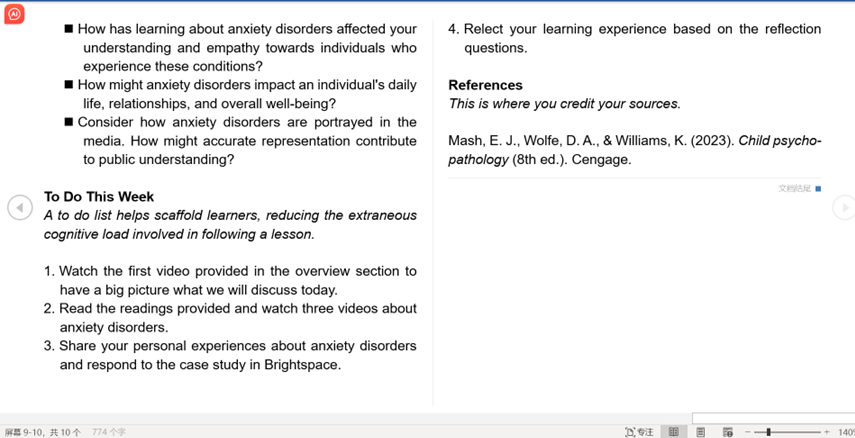
The topic of my lesson plan is anxiety disorder. Anxiety disorder is a big category, and there are many subgroups under this category. In this lesson, I plan to explain different types of anxiety disorder including specific phobia, generalized anxiety disorder and social anxiety disorder and their symptoms. However, having anxiety does not mean having disorders, so it is quite important to understand the boundary between normal and abnormal. The content should be used for learning purposes only, and should not be used to make the diagnosis 🙂

lynnewang
2023-11-19 — 2:09 pm
Thanks for your hard work! I really like your lesson plan, I can see your effort on it. The lesson plan looks very clear and logical, with rich amount of details and is also well structured. The categorization of different aspects about anxiety is clearly divided and the following points under each catergory is written neat and orderly, and also esay to read and follow. Nice work! Also I can’t agree more with your thoughts about the advantage of passive learning in this course. I also feel less pressure when I can arrange my own time to learn the materials and let my brain to take rest when I feel like it in order to avoid overload. The availableness of materials at all time also makes me feel less intense in learning the contents which I think I actually learn better by exposing to the material multiple time as we can access those materials as many time as we want. Good job on this week’s reflection!